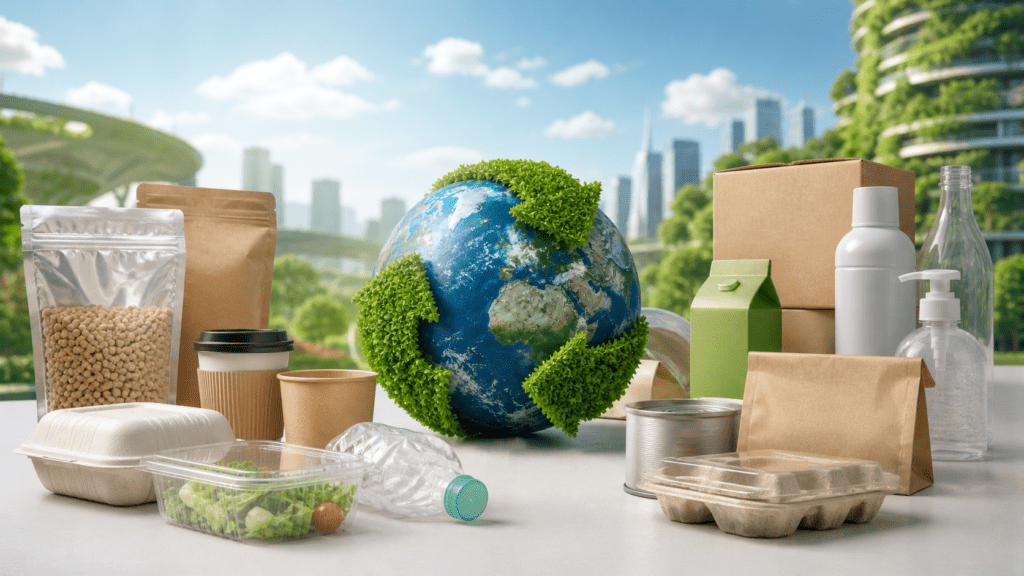
Every morning, before you finish your first cup of coffee, you’ve already interacted with packaging innovation dozens of times — the plastic bottle of drinking water, the sealed bread bag, the juice carton, even the film-wrapped fruit. Have you ever wondered how all of this came to be?
The history of packaging innovation is not just a story of materials and technology. It’s a story of human ingenuity solving one of civilization’s most fundamental problems: how do we keep food safe, fresh, and transportable?
In ancient times, humans stored food in clay pots, banana leaves, reed baskets, or animal skins. These solutions worked — but only barely. Food spoiled quickly. Preserving meat required heavy salting. Grains had to be consumed before insects and moisture could ruin them. Long journeys meant food scarcity, and armies and explorers often suffered more from hunger and spoiled provisions than from enemy action.
The core challenge was always the same: how to separate food from the oxygen, bacteria, and moisture that cause it to decay.
The first great leap forward came in 1809, when French chef and confectioner Nicolas Appert discovered that food sealed in glass jars and heated to high temperatures could be preserved for months without spoiling. He was responding to a challenge from Napoleon’s government, which desperately needed a way to feed its armies on campaign.
Appert’s method — which we now call canning — didn’t require him to understand why it worked (Louis Pasteur’s germ theory was still decades away). He simply observed that heat + sealed container = preserved food. Within a year, Peter Durand in England patented the tin can, and industrial food preservation was born.
This single innovation changed the course of history. Sailors could now travel for months without scurvy. Soldiers could be fed across continents. Cities could grow beyond what their immediate agricultural surroundings could support.
1. Modified Atmosphere Packaging (MAP)
2. Active and Intelligent Packaging
3. Tetra Pak — The Aseptic Revolution
4. The Stand-Up Pouch (Doypack)
Modern packaging doesn’t just protect food — it communicates, persuades, and creates emotional connection.
Studies consistently show that consumers make purchasing decisions in under 7 seconds at the shelf, and that packaging design drives a significant portion of those decisions. The “unboxing experience” has become a genuine marketing category, with brands spending millions to design packaging that delights customers at the moment of opening.
Functional innovations have followed: easy-open tabs for elderly consumers, single-serve portions for urban singles, microwave-safe trays for convenience, child-resistant closures for safety. Each of these represents a packaging engineer solving a real human problem.
No story of packaging innovation is complete without acknowledging plastic’s double-edged legacy. Plastic packaging revolutionized food safety, reduced food waste, and made nutrition accessible at global scale. A plastic-wrapped cucumber lasts 11 days longer than an unwrapped one. The carbon footprint of the packaging is often far smaller than the carbon footprint of the food it would have wasted.
And yet: over 380 million tonnes of plastic are produced globally every year. Much of it is single-use packaging. Only about 9% of all plastic ever produced has been recycled. The rest sits in landfills, drifts through waterways, or breaks into microplastics that have now been found in human blood, breast milk, and placentas.
This is the central challenge facing packaging innovation today. The industry is responding with:
For Thai food and beverage businesses — from large exporters to small SMEs — the packaging landscape is shifting rapidly. Export markets in Europe and the US are increasingly demanding sustainable packaging, with regulations like the EU Packaging and Packaging Waste Regulation (PPWR) setting mandatory recycled content and recyclability requirements that will affect imported products.
Thai consumers, especially younger urban demographics, are also showing growing preference for brands with credible sustainability commitments. Packaging is often the most visible expression of those commitments.
At the same time, functional requirements remain paramount: food safety, shelf-life extension, moisture and heat resistance in Thailand’s climate, cost-effectiveness for price-sensitive markets. The challenge for Thai businesses is to navigate all of these factors simultaneously — choosing packaging that is safe, functional, commercially viable, and increasingly sustainable.
The good news is that the range of available solutions has never been wider. The key is knowing which innovations fit your specific product, market, and supply chain.
Whether you’re launching a new product, reformulating an existing one, or looking to transition to more sustainable packaging — the right choice depends on a careful analysis of your product’s requirements, your target market, and your production capabilities.
Contact us today to consult with our packaging specialists. We help Thai food and beverage businesses — from startups to established exporters — navigate the full range of packaging options and find solutions that protect your product, represent your brand, and meet the demands of today’s market.